
Emergency Roof Repair Near Me: What Costa Mesa Homeowners Should Do First
If you have an active roof leak or storm damage in Costa Mesa, your first move is not to call a roofer. Your first thirty minutes should go to water mitigation, documentation, and a ground-level safety check, in that order. Get that sequence right and you’re looking at a manageable repair. Get it wrong and a $900 patch becomes a $9,000 remediation project. If you’d rather not handle any of this yourself, call Spartan Roof Repair at (855) 382-3237 and we’ll walk you through it.
The 30-Minute Action Sequence: Before You Touch the Phone
Costa Mesa sits in a particular weather pattern. We get months of dry heat, then sudden winter downpours that overwhelm drainage. We also get Santa Ana winds that peel flashing, lift shingle edges, and send tree limbs through decking. When damage happens, adrenaline says call someone immediately. Adrenaline is wrong.
Here’s your sequence, in order:
- Stop the water at the source of entry. If you can identify where it’s coming in, position a bucket, a trash can, anything. Move furniture, electronics, and rugs out of the path. Water spreads laterally in Costa Mesa’s typical attic spaces, which means the ceiling stain you see may be three feet from the actual roof breach. Contain what you can and mark the visible damage with painter’s tape.
- Document everything before anyone touches the roof. Photograph the interior damage, the ceiling stain, the wall streak, the pooled water. Then photograph the exterior from the ground. Insurance adjusters need to see the roof in its pre-repair condition. Once a contractor lifts a shingle or re-seats flashing, the evidence changes. Shoot wide shots to establish location and close-ups to show the specific breach.
- Do a ground-level structural check. Walk the perimeter. Look for sagging ridge lines, displaced tiles, lifted shingle edges, or debris impaled through the decking. Do not get on a ladder after a storm. Wet composite shingles and tile do not warn you before they let go. If you see a sag, a visible beam deflection, or a tree limb resting on the structure, stay out of the house and call us from the street.
- Contain what you can from the inside. If the breach is over an accessible attic and you can reach it safely from below, a plastic sheet placed over the storage items under the leak is enough. Do not attempt to push anything up through the roof. You will make the breach worse.
- Now make the call. Once you have photos, a marked damage area, and know the general location of the breach, call an emergency roofing contractor. A roofer who arrives to clear documentation makes better decisions faster.
In our experience across Costa Mesa neighborhoods like Mesa Verde and College Park, the homeowners who follow this sequence file smoother insurance claims. The ones who call first end up with a roofer who has to reverse-engineer what happened from memory. That costs time and accuracy.
How to Tarp a Roof Safely Without Getting On It
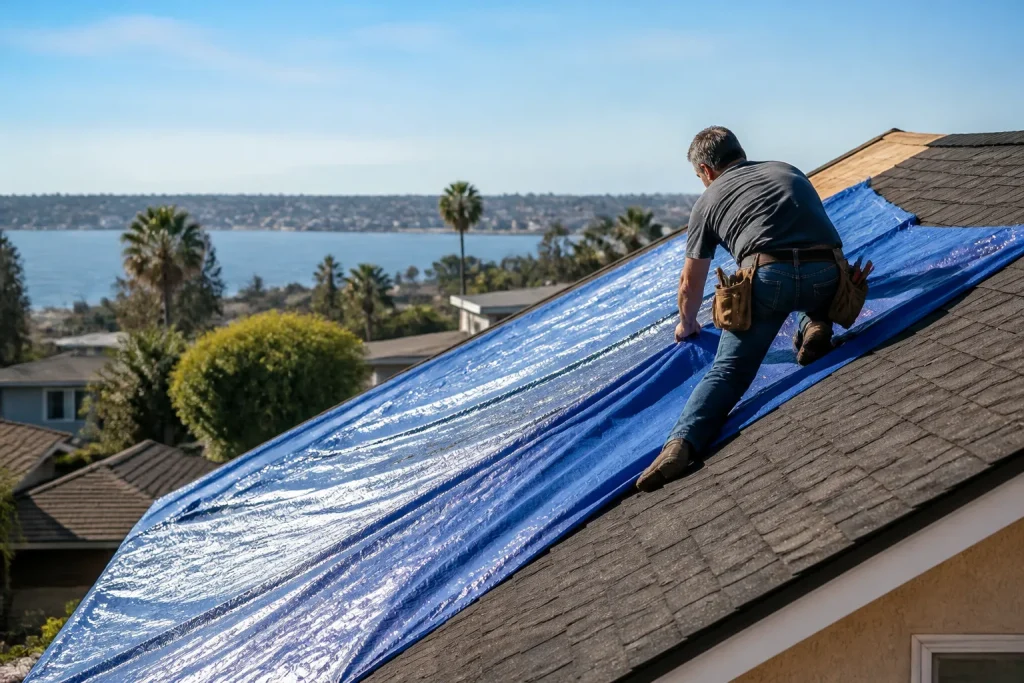
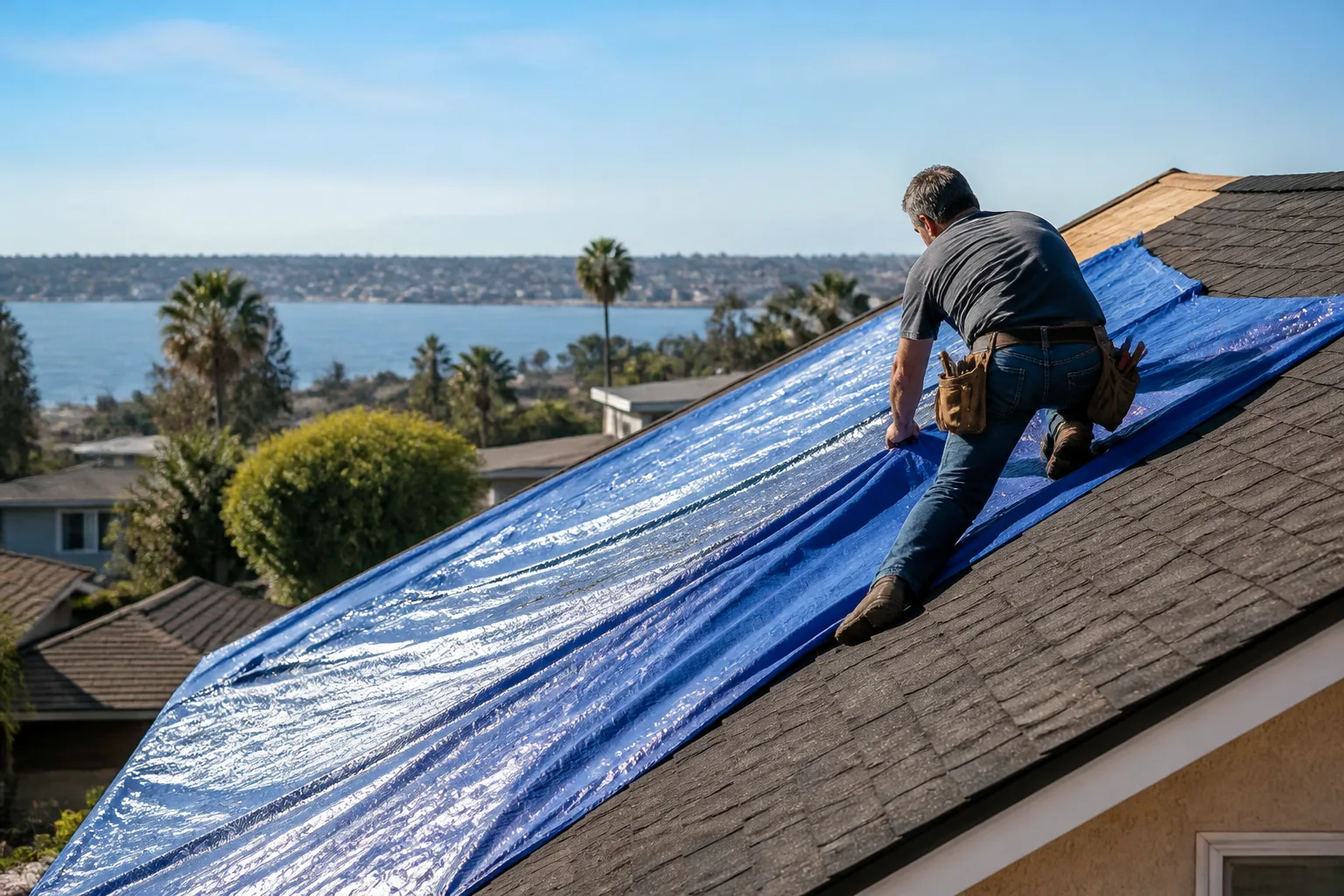
Temporary tarping stops interior damage from compounding overnight. But here is what most Costa Mesa homeowners don’t realize: you should not be the one on the roof.
A wet roof, especially after a rain event, is unpredictably slick. Tile roofs common in Costa Mesa’s older tracts have individual tiles that crack under foot pressure. Composite shingle roofs lose their granular surface when wet, and that grit acts as traction. And after Santa Ana winds, the structure may have damage you can’t see from the ground, a cracked rafter, a displaced truss, a loose decking panel.
If the breach is small and you can reach it from a single-story roof with a secure ladder, here’s what an assisted ground-level tarp job looks like:
- Use a roof-grade tarp, not a painter’s drop cloth. You want 6-mil weight minimum.
- Anchor the tarp to the ground or lower structure, never rely on a single fastener.
- Tuck the top edge under the ridge or shingle course so water sheds over it, not under it. Water follows gravity and capillary action. If you leave an exposed top edge, the tarp becomes a funnel.
- Secure with wood strips or sandbags placed along the tarp’s perimeter. Never put nails through the tarp into the roof deck. You’ve just added more breaches.
For two-story homes, steep pitches, or any roof you cannot reach safely from a sturdy ladder placed on level ground, stop. That is the moment to wait for a professional. A technician with a harness and roofing boots will inspect and tarp it correctly. A trip to urgent care with a broken ankle turns a roofing problem into a two-month problem.
Roof Repair in Costa Mesa from Spartan is exactly this kind of work, emergency tarping, breach assessment, and a straight diagnosis of what happened and what it will take to fix it. We do not send a generalist. We send a roofing technician.
What to Photograph Before Any Contractor Touches the Roof
Insurance adjusters see hundreds of claims after every major Costa Mesa storm. The claims that resolve fastest are the ones with documentation that answers the adjuster’s questions before they ask them. Here’s what they look for:
- Interior stains with scale reference. A quarter, a ruler, or a standard coffee mug placed next to the stain tells the adjuster the actual size. A photo of a dark patch with no scale means they have to guess.
- The wet path from origin to wherever it stopped. Start at the visible stain, then move your camera outward along the path water likely traveled. Include the wall, the baseboard, and any floor damage.
- The exterior breach from the ground. Wide shot first, then zoom. If you can see a lifted shingle, a missing tile, or a debris impact point, document it from multiple angles.
- Anything that shows causation. The tree limb still on the roof, the displaced roof tile in the yard, the neighbor’s broken fence panel that went through your window. Causation documentation is what changes a “wear and tear” denial into an approved claim.
- Your address in the frame. One photo with your house number visible, so the insurance company can’t question whether the photos match the property.
- Date and time stamps. Most smartphone cameras embed this automatically. Do not turn it off. It establishes the event timeline.
One more thing about Costa Mesa wind events specifically: document the weather event itself if you can. Screenshot the storm warning, photograph debris in the street, capture the wind on video. Adjusters look for patterns across the region. The more evidence you provide that this was an acute event rather than long-term maintenance neglect, the stronger your position.
We inspect roofs, we repair them, we replace them. But before any of that happens, we need you to be the documentarian. It’s the step most homeowners skip, and it’s the step that costs them real money later. That’s a straight answer about your roof, and it’s the only kind we give.
The Three Questions to Ask Any Emergency Roofer Before They Show Up
When water is coming through your ceiling at 2 a.m., it’s easy to call the first number that picks up. And in Costa Mesa, especially after a major wind event, not every number that answers is a local roofing company. Some of them are storm-chasers, out-of-state crews that follow weather disaster patterns, patch fast, and disappear before the warranty matters.
Here are three questions to ask before anyone gets out of their truck:
- “What is your California contractor’s license number?” A real local contractor has one and will give it to you without hesitation. You can verify it on the Contractors State License Board website while they’re still on the phone. A storm-chaser will deflect, give a license from another state, or claim their license is “in the truck, let me call you back.”
- “Are you a roofing-only company, or do you also do general contracting?” This is not snobbery. A roofing-only specialist deals exclusively with roof structures, roof drainage, flashing, underlayment, and decking. A generalist who did a bathroom remodel last week is not the technician you want evaluating structural roof integrity after a Santa Ana event. We’re roofing specialists, not generalists, and that focus is the entire reason repair diagnoses tend to be faster and more accurate.
- “What will you do about this right now, and will you put that in writing before you start?” You want a clear, immediate plan: tarp the breach, assess the structure, provide a written scope of work, and identify whether this is a repair or replacement scenario. Anyone who says “we’ll figure it out when we’re up there” without a preliminary plan is going to figure out how to expand the job once they’re on the roof.
We pulled one out of a garage over in the Eastside neighborhood last year where a homeowner had already signed with an out-of-state crew before calling us for a second opinion. The contract had no scope of work, no line-item detail, and a “reasonable cost” clause. It took her three weeks to untangle. She eventually got the repair done properly, but she lost the window where insurance would have covered the full claim. Do not sign anything in the first 24 hours after a storm unless you can answer all three of those questions yourself.
The Storm-Chaser Pattern: What It Looks Like in Costa Mesa
Costa Mesa’s Santa Ana events are predictable enough that out-of-area crews plan around them. They arrive within 48 hours of a major wind event, canvass neighborhoods, and put pressure on homeowners with lines like “we’re already in your area” and “we can do it today if you sign now.” Here’s the pattern to recognize:
- Unmarked trucks with out-of-state plates. Local roofing companies have marked vehicles and local plates. It’s a small thing, but the pattern holds.
- Door-to-door canvassing with a clipboard and a “free roof inspection.” A legitimate roofing contractor does not need to canvas a neighborhood 48 hours after a storm. The work finds them.
- Pressure to sign a contract before the insurance adjuster visits. Storm-chasers want their signature on paper before the adjuster has a chance to document the damage independently. Once you’ve signed a contract, the adjuster’s findings are working against you.
- No local references, no local phone number, no local address. Ask for a Costa Mesa or Orange County project they’ve completed in the last year. If they can’t produce one, walk.
None of this means every out-of-town roofer is bad. It means that in the first 24 hours after storm damage, your judgment is impaired by stress and you’re vulnerable to urgency-based sales. The right move is to wait for your adjuster, document your damage, and get at least one more opinion. A straight answer about your roof should not require you to sign something on a clipboard in your front yard.
When you do get to replacement territory, here’s the thing most Costa Mesa homeowners don’t hear from their contractor: material choice matters as much as labor. We work with GAF, CertainTeed, Owens Corning, IKO, Atlas, and Tamko, seven of the industry’s most trusted roofing brands. For a Costa Mesa home in a hot, dry climate with intermittent wind stress, that breadth means we can recommend what actually fits the house rather than what we happen to have in stock. It’s the difference between roof replacement in Costa Mesa done once, correctly, and a redo in eight years.
The Bottom Line
A roof emergency in Costa Mesa breaks down into this: contain the water, document the damage, check safety from the ground, then call a roofing specialist who can give you a clear answer without a sales script. The homeowners who do it in that order get smaller repairs, smoother claims, and fewer surprises.
If you’re in Costa Mesa and need help, Spartan Roof Repair offers free estimates, same-day emergency response when we can get a crew out, and a written scope of work before anything gets touched. We inspect it, we repair it, we replace it. Built to last, not built to impress. Call (855) 382-3237.
Frequently Asked Questions
Most emergency roof repairs in Costa Mesa run between $350 and $1,800 depending on the breach size, the roof type, and whether structural repair is needed. A simple flashing re-seal is on the low end. A tarp-and-stabilize with decking replacement runs higher. Call (855) 382-3237 for an exact quote, estimates are free.
Most standard homeowner’s policies cover sudden, accidental damage from storms, wind, or falling debris. They may not cover damage from long-term wear or deferred maintenance. Document the event and the damage before any contractor touches the roof, and call (855) 382-3237 if you need help understanding what your policy likely covers.
You should not wait more than 24 hours. Water spreads through attic insulation and drywall quickly, and in Costa Mesa’s mild post-rain conditions, mold can establish within 48 hours. The longer you wait, the larger the restoration scope becomes. If you’re not sure whether it’s urgent, call (855) 382-3237 and describe what you see, we’ll tell you straight.
For repair work under the city of Costa Mesa’s permit threshold, typically no permit is required. For structural repair or replacement, yes, permits are required and we handle them as part of the scope of work. We’ll tell you before work starts whether your job needs one. Call (855) 382-3237 and we’ll walk you through what the city requires.
Written by the team at Spartan Roof Repair, serving Costa Mesa since 2017.
Need Roofing Help?
Call Spartan Roof Repair — licensed & insured, here with fast after-hours help in Bellflower.
(855) 382-3237